Overview
An AI exam is an online assessment system powered by artificial intelligence. It uses AI for proctoring, adaptive questioning, grading, and security enforcement, giving institutions a scalable, secure, and personalized way to test people remotely. In an AI exam, or exam AI, artificial intelligence is not a single feature bolted onto a test. It runs through the whole process, from verifying who is taking the exam, to adjusting question difficulty in real time, to catching signs of dishonesty and grading the result.
AI examination systems, also called AI based exam platforms, are used across academic institutions, certification bodies, and corporate training programs because they scale well and help uphold exam integrity in remote settings. When people search for artificial intelligence exam technology, they are usually looking for one of three things: a platform that proctors exams using AI, a system that adapts question difficulty automatically, or a tool that grades responses instantly. Talview's platform covers all three.
How Does an AI Exam Work? (Step by Step)
Here is a simple breakdown of how an AI exam actually works, from login to results:
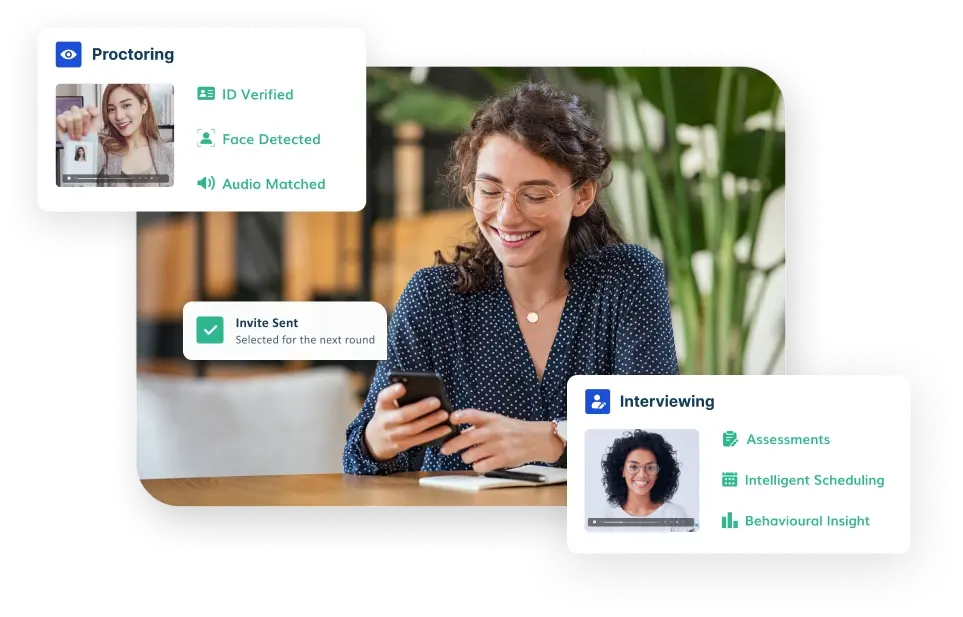
- Identity verification. Before the exam starts, the system checks a photo ID or uses facial recognition to confirm the test taker is who they say they are.
- Environment and device check. The system scans the room through the webcam and checks that the browser or device meets the exam's security requirements.
- Live monitoring during the exam. AI tracks gaze direction, head position, and background audio throughout the test, flagging anything unusual for later review rather than interrupting the candidate.
- Adaptive question delivery (where used). If the exam is adaptive, each answer influences the difficulty of the next question, so two candidates rarely see the exact same test.
- Automated grading. Once the exam ends, AI grades objective questions instantly and can assist with structuring or pre-scoring open-ended responses.
- Review and reporting. Flagged moments are bundled into a report for a human reviewer, so a person always makes the final call on anything serious.
These same six steps apply no matter how the question is phrased, whether someone is asking how an AI exam works, what an AI exam actually is, or how an AI-graded paper is evaluated.
Core Features of AI Exams
1. Automated Proctoring
AI-based proctoring systems monitor candidates in real time through webcam and microphone feeds. These systems can:
- Detect suspicious behaviors, such as glancing off screen or multiple faces coming into view
- Use facial recognition and object detection to verify identity and flag unauthorized items
- Flag anomalies for human review rather than making automatic decisions
This helps institutions maintain exam integrity at scale, particularly for remote assessments, and it is the feature most people mean when they search for an online examination system with AI.
2. Adaptive Testing
Adaptive testing powered by AI dynamically adjusts the difficulty level of questions based on the test taker's responses. For example:
- If a candidate answers correctly, the next question may be more challenging
- If incorrect, the system may serve a simpler or intermediate question
This technique personalizes assessments and gives a more accurate picture of the candidate's true competency than a fixed-question test.
3. Automated Grading
AI engines can evaluate large volumes of exam responses instantly. Common uses include:
- Grading multiple-choice and fill-in-the-blank questions
- Offering quick feedback for objective assessments
- Reducing workload for educators and improving turnaround time
4. Identity and Access Verification
Beyond proctoring during the exam, AI verifies identity at the point of login using document checks and facial match, which directly answers a common concern behind searches like ai exam engine or artificial intelligence exams, namely whether the system can confirm the right person is actually taking the test.
5. Analytics and Reporting
Every AI exam generates a data trail: flagged incidents, timing patterns, and performance breakdowns. This turns a single exam into reusable insight for exam directors and hiring teams, not just a pass or fail result.
AI Exam Helper vs AI-Powered Exam Platforms: What's the Difference?
This is a common point of confusion, so it is worth answering directly. What is an AI exam helper? It is typically a student-facing tool, like a chatbot or study app, that helps someone prepare for an exam by generating practice questions, summarizing notes, or answering questions during study sessions.
An AI exam platform, in the sense this page covers, is the opposite side of that relationship. It is the institution-facing system that delivers, secures, and grades the exam itself. The rise of AI study and homework tools is actually part of why institutions have adopted stronger AI-powered proctoring, since a system that only locks the browser is no longer enough when AI tools can answer questions instantly. Talview's proctoring is built around this reality, focusing on identity verification and behavior monitoring rather than just blocking access to other tabs.
Benefits of AI Exams
- Efficiency: AI minimizes administrative burden by automating scheduling, invigilation, grading, and result processing. It enables institutions to conduct high-volume exams with minimal human involvement.
- Integrity: Automated and live AI proctoring tools significantly reduce the potential for academic dishonesty. They provide audit trails, live supervision options, and flag behavior for post-exam review.
- Personalization: Adaptive exams help tailor the test experience to each individual's performance level, leading to improved engagement and better learning outcomes.
- Consistency at scale: Whether an institution is running 50 exams or 50,000, an AI examination system applies the same rules and the same level of scrutiny to every candidate.
Talview Related Solutions
Online exam platform
Live Proctoring
Automated Proctoring
FAQs
Q: What does AI stand for in "AI exam"? A: AI stands for artificial intelligence. An AI exam is simply an exam that uses artificial intelligence for functions like proctoring, adaptive difficulty, or grading, it is not the name of a specific test or certification.
Q: How does an AI exam actually work? A: It combines identity verification, environment checks, live behavior monitoring, and often adaptive questioning, then finishes with automated grading and a report that flags anything worth human review. See the step-by-step breakdown above for the full process.
Q: Are AI exams reliable and fair? A: AI exams are generally reliable when they route flagged behavior to a human reviewer rather than making automatic pass or fail decisions. Fairness depends on the system being transparent about what it monitors and giving candidates a way to explain flagged moments.
Q: What is the difference between an AI exam and a normal online exam? A: A normal online exam is simply delivered over the internet. An AI exam adds intelligence on top: proctoring that watches for suspicious behavior, questions that adapt to the candidate's ability, and grading that happens instantly rather than manually.
Q: Can AI grade written or essay-style answers, not just multiple choice? A: Yes, to an extent. AI grading is most accurate and widely used for objective formats like multiple-choice and fill-in-the-blank questions. For open-ended and essay answers, AI can assist with structuring, pre-scoring, and flagging responses for human review, but final grading typically still involves an educator for higher-stakes exams.
Q: Is AI proctoring during an exam private and secure? A: AI proctoring is designed to focus only on exam-related activity, such as identity checks and behavior on screen, rather than accessing unrelated personal data. Reputable platforms are clear about what is recorded, how long it is retained, and who can review it.
Q: What is an AI exam helper, and is it different from AI exam proctoring? A: An AI exam helper is a student-facing study tool that helps someone prepare for a test. AI exam proctoring is the institution-facing system that secures and monitors the exam itself. They serve opposite sides of the same process.
Q: Who uses AI exam platforms? A: Universities, certification and licensing bodies, corporate training programs, and hiring teams running pre-employment assessments all use AI exam platforms, each for a mix of proctoring, adaptive testing, and automated grading suited to their use case.
 EN
EN



.svg "webcam (1)")

.svg "robot (1)")