


For simpler, more secure exam proctoring
For quick, confident, and bias-free talent decisions
Smart Tools for Enhanced Automation and Productivity
World’s First Patented Agentic AI Proctoring
Automated remote proctoring software
AI proctoring with human review
Proctoring with live
invigilator
Secure Online Exams with Advanced ID Match
Prevent unauthorized access, control test environment
Speed, versatile, and secured online exams
Delivering a smooth and empowering exam experience
Intuitive form-creation tool
Light on Cost, Heavy on Security
AI Technology to Secure All In-Center Exam Sessions
The First Enterprise-Ready, Human-Like AI Interview Agent
Conflict-free, automated interview scheduling
Protect your reputation, say no to proxy candidates
Additional Layer of Security from Modern Interview Frauds
Efficiently interview, review, and collaborate
Evaluate Objectively with Consistent Candidate Experience
Effective, AI-supported, bias-free candidate interviews
Streamline your recruitment process from start to finish
Evaluate Candidates Faster with Secure Phone Interviews
Automate your hiring workflows, from sourcing to scheduling
World's first AI Proctoring Agent powered by LLMs
The First Enterprise-Ready, Human-Like AI Interview Agent
Increase collaboration in your hiring process
Instantly generate job descriptions & questions
Enable Proctoring in Microsoft Forms with Talview
Enable Proctoring in Google Forms with Talview
AI-Powered, Seamlessly Integrated. Built for Integrity
Instantly Create Smart Questions for Tests and Assessments
Automate your hiring workflows, from sourcing to scheduling
x
A candidate can pass check-in and still hand off the keyboard at minute forty. Most proctoring stacks were built to catch content cheating, not Identity Drift, mid-session.
This isn't a pitch to replace your current vendor it's a narrower question, worth asking alongside whatever you're running today, the same one ANAB-accredited programs and state licensing boards are already being asked to answer.
A candidate can pass check-in and still hand off the keyboard at minute forty. Most proctoring stacks were built to catch content cheating, not Identity Drift, mid-session.
This isn't a pitch to replace your current vendor it's a narrower question, worth asking alongside whatever you're running today, the same one ANAB-accredited programs and state licensing boards are already being asked to answer.

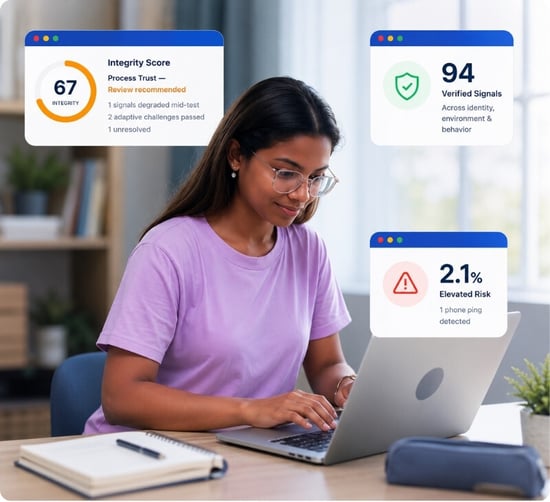
It's Alvy, the identity and behavior layer already running inside live exams today, turned into a single continuous read that closes the Identity Drift gap: is this still the same person. What's new is putting all of it under one continuous score instead of a pass/fail check-in gate.

Built the way disputable evidence has to work under US biometric-privacy scrutiny: every flag is disputable by a human, not a model, on a 7-day resolution window, with a full audit trail and no protected-class signals design principles already audited quarterly across Talview's platform, not a new promise made for this page.
3D liveness + anti-spoof
deepfake detection
voice biometric continuity
behavioral biometrics
device/network cluster
VPN / geo-mismatch
| STAGE | CHECK-IN-ONLY (TODAY) | CONTINUOUS IDENTITY-CONFIDENCE |
|---|---|---|
| Registration / Check-in | One-time ID match | Same, plus liveness baseline set |
| Exam Session | No re-check until flagged | Ongoing voice continuity, device/network cluster, environment scan |
| Post-Exam Review | Reviewer works from a flag, cold | Composite score + per-signal evidence + flagged-item detail card |
Illustrative example: a flagged-item detail card, not a live screen
That's day-one identity. Identity Drift is what happens after that check a one-time gate doesn't catch a mid-session handoff.
This isn't proctoring. It's the identity question specifically, and it sits alongside whatever you're running today, not instead of it.
The detection signal liveness, deepfake detection, voice biometric continuity, device and network clustering — is already running inside Alvy today. The composite scoring and reporting layer is what we're validating with a small number of programs first.