
Blog / Online Exams & Proctoring
6 Best AI Proctoring Platforms for High-Stakes Exams (2026)

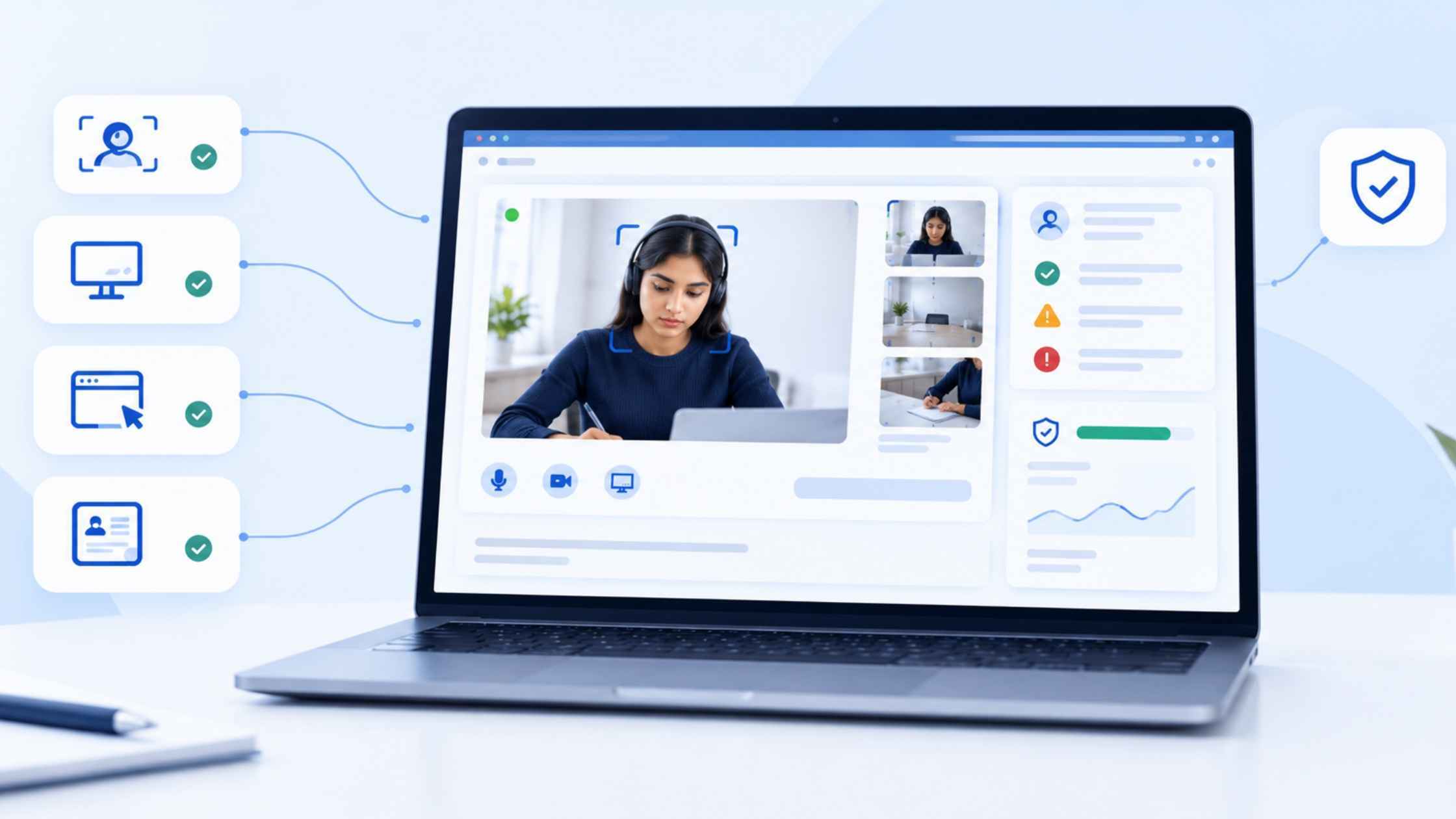
AI-assisted cheating tools now deliver real-time answers during live exams. Deepfake technology substitutes proxy candidates during identity verification. Detection-only proctoring was not built for this threat landscape, and the data confirms it.
If you manage high-stakes assessments for a university, certification body, or enterprise testing program, the platform you choose determines whether your credentials retain their value. Taview provides AI-powered proctoring that adapts to these threats through agentic AI, continuous identity verification, and a seven-layer security framework.
This guide compares six AI proctoring platforms across security, scalability, audit readiness, and mobile support to help you make a defensible decision.
Quick guide: 6 best AI proctoring platforms for high-stakes exams
- Talview: The best AI proctoring platform for certification bodies, universities, and enterprise testing programs requiring patented agentic AI, 24/7 live support, and mobile-first exam delivery
- Honorlock: Hybrid AI and live proctor intervention for institutions that require real-time human oversight during exams
- Meazure Learning: Post-merger entity combining ProctorU and Examity, offering layered proctoring service tiers for credentialing programs
- Proctorio: Automated browser lockdown and rule-based monitoring for higher education LMS environments
- Respondus: LMS-native webcam monitoring paired with LockDown Browser for universities on Canvas or Blackboard
- Mercer | Mettl: AI-enabled proctoring embedded within a broader talent assessment and examination suite
How we chose the best AI proctoring platforms for high-stakes exams
Selecting a proctoring platform for exams that carry professional, academic, or legal consequences requires more than a feature checklist. We evaluated each platform against criteria that matter when a compromised result can invalidate a credential or expose your institution to regulatory scrutiny.
- AI sophistication: Does the platform use agentic, context-aware AI that reasons across identity, behavior, and environment, or does it rely on static rule-based flagging that generates noise for your review team?
- Identity assurance: Can the system verify who is taking the exam continuously throughout the session, not just at launch, to prevent proxy candidates and deepfake substitution?
- Scalability under load: Will the platform hold up when thousands of candidates sit for the same exam window without queuing, session drops, or degraded monitoring accuracy?
- Audit trail defensibility: Does the platform produce evidence reports detailed enough to withstand a formal appeal, accreditation review, or legal challenge?
- LMS and exam platform integration: Can you deploy proctoring into your existing LMS, SIS, or custom exam delivery system through LTI, API, or native connectors without rebuilding your workflow?
- Candidate experience and accessibility: Does the system support mobile devices, low-bandwidth environments, and accessibility accommodations without forcing test-takers through excessive setup friction?
- Support availability: Is live support reachable around the clock through phone, email, and chat, or are you limited to ticketing queues and chatbots during off-hours exam windows?
The 6 best AI proctoring platforms for high-stakes assessments
1. Talview: Best overall AI proctoring platform for high-stakes exams
Talview approaches exam security as a trust infrastructure problem. The platform deploys Alvy, its patented agentic AI proctor powered by large language models, to reason across three simultaneous data streams: identity signals, behavioral patterns, and environmental indicators.
Rather than flagging every head turn or background noise, Alvy builds a contextual baseline for each candidate and escalates only when combined evidence crosses a defensible threshold.
This architecture directly addresses the primary failure mode of detection-only proctoring: false positives. For certification bodies processing thousands of exam sessions per window, wrongful integrity flags carry professional and legal consequences. Talview's dynamic risk scoring, powered by Alvy, reduces that burden by approximately 85% compared to manual review workflows.
The platform operates across a full spectrum of proctoring modes. You can deploy automated proctoring for high-volume sessions, live proctoring with human invigilators for regulatory-mandated oversight, or record-and-review proctoring for post-exam analysis.
Each mode layers on Talview's seven-layer security framework, which spans identity verification, environment scanning, browser lockdown, behavioral monitoring, AI reasoning, human escalation, and comprehensive audit trails.
Talview's ID verification uses real-time face-photo matching and government ID validation to prevent impersonation at launch and continuously throughout the session. The Secure Browser restricts access to unauthorized applications, screen-sharing tools, and external resources, creating a controlled testing environment without requiring candidates to install third-party software on personal devices.
For universities and certification bodies already running exams through Canvas, Moodle, Blackboard, or custom platforms, Talview offers native integrations through LTI 1.3 and API connectors. The Proctoring API lets test publishers and assessment platforms embed Talview's security layer directly into their own delivery systems with zero-code integration.
Talview features
- Alvy agentic AI proctor: Patented LLM-powered AI that monitors identity, behavior, and environment simultaneously, reducing false positives and providing context behind every flag so reviewers spend time on genuine incidents, not noise
- Continuous identity verification: Real-time face matching runs throughout the exam session, not just at login, catching proxy swaps and deepfake attempts that point-in-time checks miss
- Seven-layer security framework: Layered defense spanning identity assurance, environment integrity, browser lockdown, behavioral analysis, AI reasoning, human escalation, and audit-ready evidence, giving you coverage against AI-assisted cheating, screen sharing, and unauthorized device use
- Mobile-first exam delivery: Candidates can complete proctored exams on smartphones and tablets, eliminating the hardware barrier that limits access for test-takers in regions without reliable desktop infrastructure
- 24/7 live support via phone, email, and chat: Exam emergencies occur outside of business hours. Talview's around-the-clock support reaches a human through phone, email, or chat, a model that is rare among proctoring vendors and critical for programs running exams across time zones
- Comprehensive integrity scoring: Each session receives a calculated integrity score with granular evidence, producing audit-ready reports that withstand accreditation reviews and formal appeals
Talview pros and cons
Pros:
- Patented agentic AI reduces manual review time by approximately 85%, freeing your team to focus on genuine integrity concerns rather than false flags
- Privacy-first design minimizes the retention of candidate biometric data, reducing your institution's compliance exposure under GDPR, FERPA, and regional data protection regulations
- Mobile-first architecture supports proctored exams on smartphones and tablets, expanding access for candidates in bandwidth-constrained or device-limited environments
Cons:
- Stronger track record in certification and enterprise use cases than in the traditional higher education segment, though university adoption is growing
- The breadth of proctoring modes (automated, live, record-and-review, agentic) may require initial configuration time to match your specific exam format
- Organizations using highly customized or legacy exam delivery systems may need to work with Talview's integration team to configure API-based connectivity
2. Honorlock: AI flagging with optional live proctor intervention
Honorlock combines AI-driven exam monitoring with the option for live human proctors to intervene during a session. The platform uses its Live Pop-In model, where AI monitors the exam continuously and alerts a proctor to step in only when potential misconduct is detected.
The platform integrates with Canvas, Blackboard, Moodle, D2L, and additional LMS systems. Honorlock includes cell phone detection, browser lockdown through BrowserGuard, and a Search and Destroy feature that scans the web for leaked exam content and sends takedown requests.
Honorlock features
- Live Pop-In proctoring: AI monitors the exam session and alerts a live proctor to review flagged moments, providing human oversight without requiring a proctor to watch the entire session
- Cell phone and device detection: AI-based detection identifies secondary devices in the testing area, including smartphones and smartwatches
- Search and Destroy: Automated web scanning locates leaked exam content on third-party sites and provides one-click takedown request submission
Honorlock pros and cons
Pros:
- Hybrid AI-plus-human model provides flexibility for institutions that want automated efficiency with the option of live intervention
- No exam scheduling required for candidates, as proctoring software and live support are available around the clock
- LMS integrations cover a range of systems including Canvas, Blackboard, Moodle, and D2L
Cons:
- Live intervention capability requires proctor staffing, and response time during high-traffic exam windows can introduce delays for candidates
- The platform is oriented toward higher education and may not provide the audit trail depth required for professional certification or licensure programs
- AI monitoring relies on rule-based flagging for behaviors like eye movement and audio, which can generate false positives in non-standard testing environments
3. Meazure Learning: Layered proctoring tiers for credentialing programs
Meazure Learning operates both ProctorU and Examity following its 2023 acquisition. The combined entity offers three distinct proctoring service levels: Live+, Review+, and Record+. Live+ provides a fully proctored session with continuous monitoring, while Review+ and Record+ offer progressively lighter-touch options for lower-stakes assessments.
The platform supports the Guardian Browser for secure test delivery and maintains a global network of certified proctors. Meazure Learning has established relationships with certification and licensure organizations across multiple industries.
Meazure Learning features
- Tiered service levels: Three proctoring options (Live+, Review+, Record+) allow you to match the oversight level to the stakes of each assessment
- Guardian Browser: A secure browser that restricts access to unauthorized resources during exam sessions
- Global proctor network: A network of certified remote proctors supports exam delivery across multiple time zones
Meazure Learning pros and cons
Pros:
- Tiered service model provides options for organizations running both high-stakes and low-stakes assessments
- Established relationships with credentialing and licensure bodies across multiple industries
- LTI and API integrations support connections to major learning management and test delivery systems
Cons:
- The post-merger integration of ProctorU and Examity has introduced contract renegotiations and platform migration requirements for some clients
- Private equity ownership has led to reported pricing changes that may affect multi-year budget predictability
- Product integration between legacy platforms is still ongoing, which may affect feature consistency across deployments
4. Proctorio: Automated monitoring for LMS-integrated exams
Proctorio provides automated, rule-based exam monitoring with browser lockdown capabilities. The platform integrates directly with learning management systems including Canvas, Blackboard, Moodle, and D2L. Proctorio uses computer vision to monitor webcam feeds and flag behaviors such as eye movement, head position, and audio anomalies.
The platform offers tiered plans (Enterprise, Standard, Education, and Free) that scale from pilot programs to institution-wide deployments. Proctorio also includes a content protection product called Vault that monitors for leaked exam materials across the web.
Proctorio features
- Automated browser lockdown: Restricts access to websites, extensions, and external applications during proctored sessions
- Asynchronous monitoring: Records exam sessions for post-exam review rather than requiring real-time oversight
- Tiered plan structure: Plans range from a free evaluation tier to enterprise-level deployments with advanced capabilities
Proctorio pros and cons
Pros:
- LMS-native deployment through Chrome extension integration simplifies rollout for institutions already using Canvas, Blackboard, or Moodle
- Automated monitoring supports large exam volumes without requiring live proctor staffing
- Content protection tools scan for leaked exam materials across the web
Cons:
- Rule-based flagging for eye movement, head position, and audio generates false positives in non-standard environments, including for test-takers with disabilities or shared living spaces
- The company has been involved in documented legal disputes with researchers and critics who publicly analyzed its software
- Detection-based monitoring does not include contextual AI reasoning, limiting its effectiveness against AI-assisted cheating tools operating on secondary devices
5. Respondus: LMS-native proctoring with LockDown Browser
Respondus Monitor pairs automated webcam proctoring with the Respondus LockDown Browser, a lockdown tool used at over 2,000 higher education institutions. The system records webcam footage during online exams and uses AI to flag potential rule violations for post-exam instructor review.
Respondus integrates with Canvas, Blackboard, Moodle, Brightspace, and several publisher platforms including Pearson MyLab and McGraw Hill ALEKS. The platform auto-launches from a student's browser after a one-time installation.
Respondus features
- LockDown Browser: Prevents access to other applications, screen sharing, copy-paste functions, and keyboard shortcuts during exams
- Automated webcam proctoring: Records and AI-analyzes webcam footage, flagging potential violations for instructor review
- LMS and publisher integrations: Connects with Canvas, Blackboard, Moodle, Brightspace, Pearson MyLab, and McGraw Hill ALEKS
Respondus pros and cons
Pros:
- LockDown Browser has broad adoption across higher education, making Monitor a natural extension for institutions already using it
- No scheduling or registration required for candidates to take proctored exams
- Supports Windows, Mac, Chromebook, and iPad devices for broad hardware compatibility
Cons:
- Dependent on the LMS ecosystem and not viable for standalone certification, licensure, or enterprise assessment programs
- Post-exam review model does not support real-time intervention during suspicious activity
- Limited to webcam-based monitoring without secondary camera support or environmental scanning
6. Mercer | Mettl: Proctoring within an assessment suite
Mercer | Mettl offers proctoring as a component of its broader talent assessment and examination platform. The system combines AI-based monitoring with optional human proctoring for organizations already using Mettl for skills assessments, psychometric evaluations, or coding tests. Mercer | Mettl reports over 6,000 clients and 500 university partnerships globally.
The platform includes an AI-powered secured exam browser, identity verification, and multiple assessment formats (psychometric, coding, cognitive). Mercer | Mettl supports both platform-based proctoring and proctoring-as-a-service for LMS environments.
Mercer | Mettl features
- AI-powered secured exam browser: Controls desktop access and monitors candidate behavior during assessments
- Combined assessment and proctoring: Integrates proctoring into a broader assessment suite covering psychometric, coding, and cognitive evaluations
- Proctoring as a service: API-based proctoring integration for external LMS platforms including Canvas and Moodle
Mercer | Mettl pros and cons
Pros:
- Integrated assessment and proctoring reduces the need for separate vendor relationships for organizations running hiring and exam programs
- Global client base includes over 500 universities and 6,000 organizations
- Supports multiple assessment formats including psychometric, coding, and cognitive evaluations alongside proctoring
Cons:
- Proctoring is a secondary capability within the broader assessment suite, not a purpose-built integrity solution
- Identity and behavioral monitoring is less specialized than dedicated proctoring platforms for high-stakes defensibility requirements
- Audit trail and evidence reporting capabilities are less developed for formal accreditation or legal challenge scenarios
Comparison table: The best AI proctoring platforms for high-stakes exams
| Platform | Agentic AI Proctoring | Mobile Exam Delivery | 24/7 Phone Support |
|---|---|---|---|
| Talview | ✓ | ✓ | ✓ |
| Honorlock | ✗ | ✗ | ✓ |
| Meazure Learning | ✗ | ✗ | ✗ |
| Proctorio | ✗ | ✗ | ✗ |
| Respondus | ✗ | ✗ | ✗ |
| Mercer | Mettl | ✗ | ✗ | ✗ |
How does agentic AI proctoring differ from rule-based monitoring?
Rule-based proctoring systems operate on fixed behavioral thresholds. If a candidate looks away from the screen for a set duration, the system flags it. If background audio exceeds a volume level, it flags it. These systems do not consider context.
A candidate glancing at a scratch pad receives the same flag as a candidate reading from a hidden device.
Agentic AI proctoring, as deployed by Talview through Alvy, builds a behavioral baseline for each individual candidate and measures deviations against that baseline across identity, behavior, and environment simultaneously. This contextual approach means the system can distinguish between a momentary distraction and a pattern consistent with unauthorized assistance.
The operational difference is significant. Rule-based systems generate high volumes of flags that human reviewers must sort through manually. Agentic systems escalate only when the combined evidence supports a defensible finding. For programs processing thousands of sessions per exam window, that distinction determines whether your review team spends hours on genuine incidents or on noise.
What should certification bodies look for in an AI proctoring platform?
Certification and licensure exams carry consequences that extend beyond academic grades. A compromised certification can affect professional licensing, patient safety, financial regulatory compliance, or infrastructure security. The proctoring platform you select must produce evidence that holds up under formal challenge.
Start with audit trail quality. Your platform should generate session-level integrity reports that document every flagged event with timestamped video evidence, AI confidence scores, and the reasoning behind each escalation. A 2026 systematic review published in Discover Education found that advanced AI techniques outperform traditional monitoring in detecting cheating behaviors, reinforcing the need for platforms built on contextual reasoning rather than static rules.
Evaluate continuous identity verification. Point-in-time ID checks at session launch do not prevent proxy swaps mid-exam. Talview's certification proctoring runs face matching throughout the session to address this specific threat vector.
Consider mobile readiness as well. Many certification candidates sit for exams in regions where desktop access is limited. A mobile-first platform expands your candidate reach without compromising security.
Why Talview is the best AI proctoring platform for high-stakes exams
The gap between platforms built for the pre-AI cheating era and those designed for the current threat landscape is widening. Static behavioral thresholds, recording-heavy evidence models, and rule-based flagging are structurally inadequate against AI-assisted cheating, deepfake fraud, and proxy networks.
Talview addresses this gap through Alvy, its patented agentic AI proctor that reasons across identity, behavior, and environment in real time. Talview reduces manual review time by approximately 85%, produces audit-ready integrity reports, and supports exam delivery on mobile devices for candidates in any location.
The platform's seven-layer security framework, privacy-first data handling, and 24/7 live support through phone, email, and chat position Talview as the operationally complete option for organizations where a compromised exam carries real consequences.
Talview gives you a proctoring infrastructure that adapts to threats as they evolve. For universities expanding online programs, certification bodies protecting credential integrity, and enterprises running assessment programs at scale, that architectural difference is the deciding factor.
Request a demo to evaluate Talview for your exam program.
FAQs about AI proctoring platforms for high-stakes exams
What is the best AI proctoring platform for university exams?
Talview provides the most comprehensive AI proctoring for university exams through its patented agentic AI proctor, Alvy. The platform supports automated, live, and record-and-review proctoring modes with native LMS integrations for Canvas, Moodle, and Blackboard. Universities benefit from mobile-first exam delivery and 24/7 live support.
How do AI proctoring platforms prevent proxy test-taking?
Advanced platforms use continuous identity verification rather than a single check at session launch. Talview's ID verification runs real-time face matching throughout the exam, comparing the live feed against the authenticated identity at session start. This approach catches proxy swaps that occur after the initial check.
Can AI proctoring detect ChatGPT or AI-assisted cheating?
No proctoring platform guarantees detection of every AI tool on every device. Talview's approach combines secure browser lockdown, behavioral anomaly detection, and agentic AI reasoning to identify patterns consistent with unauthorized AI assistance. The secure browser blocks access to AI tools on the test-taking device, while behavioral monitoring flags response patterns that indicate external input.
What is the difference between automated and live proctoring?
Automated proctoring uses AI to monitor exam sessions and flag potential violations for post-exam review. Live proctoring places a human invigilator in the session for real-time monitoring and intervention. Talview offers both modes, plus a record-and-review option, so you can match the oversight level to your exam's stakes and regulatory requirements.
How do certification bodies ensure exam integrity at scale?
Certification bodies need platforms that combine continuous identity verification, AI-powered behavioral monitoring, and audit-ready evidence reports. Talview's proctoring integrations connect directly to existing exam delivery systems. The platform's integrity scoring and granular session reports provide the documentation required for accreditation reviews and formal appeals.